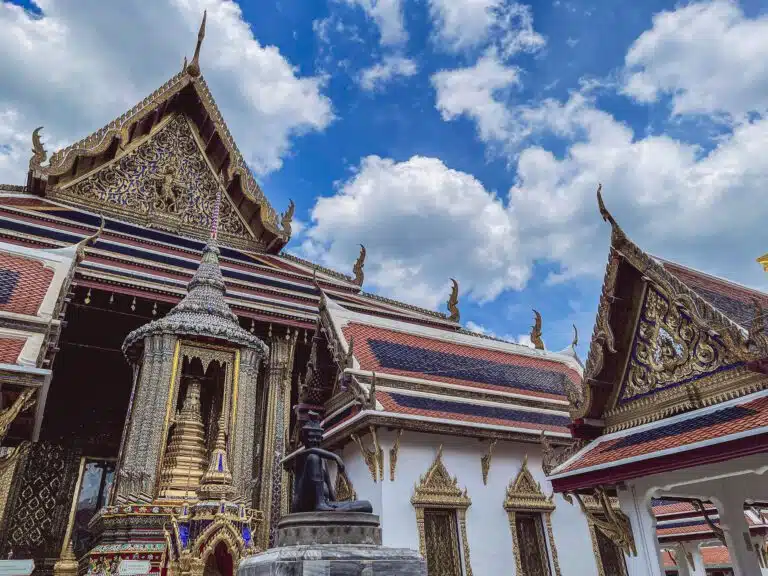
For a first trip to Bangkok, plan four days, stay near a BTS or MRT station in Sukhumvit, Siam or Silom, take the Airport Rail Link from Suvarnabhumi into the city for THB 45, and fill in your free Thailand Digital Arrival Card in the three days before you land.
That is the short version.
Bangkok rewards a little planning: the right base saves you hours in traffic, and knowing the entry rules saves you a nervous moment at immigration.
This guide covers everything you should decide before you pick an itinerary. How long to stay, when to come, how to get in from the airport and where to sleep.

Already know your dates?
Compare Bangkok hotels on Booking.com →The detail most first-timers miss: Thailand cut its visa-free stay for most nationalities from 60 to 30 days on September 15, 2026.
If an older guide told you that you can stay two months without a visa, check again before you book a long trip.
At a Glance
Where to stay on your first trip: the five best areas
Pick the area first, then the hotel. Being a short walk from a BTS or MRT station matters more than anything else.
| Area | Best for | Why stay here |
|---|---|---|
| Sukhumvit (Asok to Phrom Phong)BTS and MRT at Asok | Best forBest all-rounder | Why stay hereFood, nightlife, malls, easy airport trips |
| Siam and RatchadamriBTS interchange at Siam | Best forShoppers and families | Why stay hereCentral, flat, mall-connected walkways |
| Silom and SathornBTS Sala Daeng, MRT Si Lom | Best forCouples and foodies | Why stay hereLumphini Park, rooftop bars, night markets |
| Riverside (Charoen Krung)BTS Saphan Taksin, river boats | Best forRomance and luxury | Why stay hereGrand hotels, boat rides to the temples |
| Old Town and Khao SanRiver boats, MRT Sanam Chai | Best forSightseers and backpackers | Why stay hereWalk to the Grand Palace and Wat Pho |
Jump to each area below for what it is like and where we would book.
How many days do you need in Bangkok?
Four days is the sweet spot for a first visit.
It gives you a full day for the Old Town temples, a day for markets and Chinatown, a day for malls, parks and rooftops, and a slow day to recover from the heat.
Three days works if Bangkok is a stopover before the islands or the north.
Five days lets you add a day trip to Ayutthaya, the old royal capital, or to a floating market.

| Time you have | What it covers | Our route |
|---|---|---|
| 1 day or a long layover | Grand Palace, Wat Pho, a river boat and dinner | Bangkok in one day |
| 2 days | Old Town temples plus Chinatown and a rooftop bar | Bangkok in 2 days |
| 3 days | Adds markets, Siam and Lumphini Park | Bangkok in 3 days |
| 4 days | The full first-timer route at a relaxed pace | Bangkok in 4 days |
| 5 days or more | Add Ayutthaya, a floating market or a cooking class | Ayutthaya day tours |
When is the best time to visit Bangkok?
The best months are November to February. Days are still warm, but the humidity drops, the evenings are pleasant and rain is rare.

March to May is the hot season, when afternoons often pass 35°C.
Mid-April brings Songkran, the Thai New Year water festival, which is great fun but means closed shops and packed transport.
June to October is the rainy season. Showers are usually short and heavy in the afternoon, hotel prices drop and the city is greener.
Our guide to the best time to travel breaks it down month by month.
Before you fly: entry rules, money and phone
Visa-free stay: 30 days for most travelers
Since September 15, 2026, travelers from the US, UK, EU, Canada, Australia and many other countries can stay up to 30 days without a visa.
Some nationalities get 15 days or need a visa on arrival, so check your own passport on the Thai e-Visa site before you book.
Your passport should be valid for at least six months from your arrival date. Officers can also ask for an onward ticket and proof of funds, so keep both on your phone.
Fill in the Thailand Digital Arrival Card (TDAC)
Every foreign visitor must complete the TDAC online before arriving. It is free on the official Immigration Bureau site, tdac.immigration.go.th, and opens three days before your arrival date.
Skip the look-alike sites that charge a “service fee” for the same form.
Save the QR code you receive by email, and fill in a separate card for every traveler, children included.
You may read about a 300-baht tourist entry fee.
It has been announced several times but was not being collected at the time of writing, so there is nothing extra to pay at the airport today.
Money: cash still matters
Cards work in hotels, malls and most restaurants, but street food, markets, boats and taxis want baht.
Thai ATMs charge foreign cards a fixed fee of around THB 220 to 250 per withdrawal, so take out larger amounts less often.
When an ATM or card machine offers to charge you in your home currency, decline and pay in baht.
The conversion rate is almost always worse.
Phone and apps
Buy an eSIM before you fly or a tourist SIM at the airport arrivals hall.
Install Grab or Bolt for taxis and food delivery, and Google Maps works well for the BTS and MRT.
Be careful on public Wi-Fi. Airport, cafe and hotel networks are open to everyone. A VPN such as ExpressVPN keeps your bookings and banking private.
What to pack
Light, breathable clothes, a compact umbrella in the rainy season and comfortable shoes you can slip off at temple doors.
For the Grand Palace and the big temples, you need covered shoulders and knees, so pack one pair of long trousers or a long skirt.
Getting from the airport to your hotel
Bangkok has two airports.
Most long-haul flights land at Suvarnabhumi (BKK), east of the city, while budget and regional airlines use the older Don Mueang (DMK) in the north.

| Option | From | Cost | Time | Best for |
|---|---|---|---|---|
| Airport Rail Link to Phaya Thai | Suvarnabhumi, basement level | THB 45 | About 30 minutes | Hotels near the BTS, light luggage |
| Public taxi from the official rank | Suvarnabhumi, Level 1 | About THB 400 to 550 all in | 45 to 90 minutes | Families, heavy bags, late arrivals |
| Grab or Bolt | Both airports | Similar to a taxi, shown upfront | 45 to 90 minutes | A fixed price without the queue |
| A1 airport bus to Mo Chit | Don Mueang | THB 30 | About 30 minutes | Connecting to the BTS |
| SRT Red Line | Don Mueang, via the skywalk | THB 33 | About 20 minutes | Connecting to the MRT Blue Line |
A taxi from the official Suvarnabhumi rank runs on the meter.
You pay a THB 50 airport surcharge on top, plus expressway tolls of around THB 70 to 75 in cash at the booths.
Ignore anyone in the arrivals hall offering a “taxi” at a flat price. Head down to the official public taxi kiosk and take a queue ticket.
Our step-by-step guides cover every option: Suvarnabhumi Airport to the city and Don Mueang Airport to the city.
Where to stay in Bangkok for the first time
Bangkok traffic is the one thing that can spoil a first trip. Stay within a five-minute walk of a BTS or MRT station and you can skip most of it.
Sukhumvit: the best all-rounder
The stretch between BTS Asok and Phrom Phong has the widest choice of hotels, restaurants, bars and malls, and Asok is also an MRT interchange.
From here you reach the Airport Rail Link at Phaya Thai or Makkasan in minutes.

It is busy and built up rather than pretty. See our best hotels in Sukhumvit and Sukhumvit district guide.
Siam and Ratchadamri: for shoppers and families
Siam is the center of the BTS network, where both lines meet. Covered skywalks link the big malls, which helps a lot on hot or rainy days with children.
It gets quiet at night outside the malls. Our list of the best hotels in Siam covers every budget.
Silom and Sathorn: for couples and food lovers
Silom mixes office towers with street food, Lumphini Park and some of the city’s best rooftop bars. BTS Sala Daeng and MRT Si Lom sit side by side, so both lines are easy to use.
See the best hotels in Silom for our picks.
Riverside: for romance and grand hotels
The Chao Phraya River is where Bangkok’s most famous hotels stand.
Hotel shuttle boats and the Chao Phraya Express connect you to BTS Saphan Taksin and upriver to the temples.
It costs more and is farther from the nightlife. Read our Chao Phraya River guide before you decide.
Old Town and Khao San: for sightseers and backpackers
Stay here and you can walk to the Grand Palace and Wat Pho before the tour buses arrive. Khao San Road is the backpacker hub, loud late at night, while the lanes around it are calmer.

There is no BTS here, so you rely on river boats, the MRT at Sanam Chai and taxis. See the best hotels on Khao San Road.
Prefer old shophouses and street food? Chinatown is a characterful alternative, with MRT stations at Wat Mangkon and Hua Lamphong.

Best luxury hotels for a first trip
- Mandarin Oriental, Bangkok: the legendary riverside grande dame, with its own boats across the river to the spa.
- Capella Bangkok: an all-riverfront hideaway on Charoen Krung, every room facing the Chao Phraya.
- Kimpton Maa-Lai Bangkok: on leafy Langsuan Road near Lumphini Park; read our full review.
- Sindhorn Kempinski: calm and spacious, also in Langsuan; see our hotel guide.
- The Standard, Bangkok Mahanakhon: playful design inside the King Power Mahanakhon tower, steps from BTS Chong Nonsi.
More ideas in our best hotels in Bangkok and luxury hotel guides.
Getting around Bangkok
The BTS Skytrain and MRT subway are fast, cool and cheap, with most rides between about THB 17 and 47.
On the MRT you can tap a contactless bank card at the gate, while the BTS still needs a ticket or a Rabbit card.
A common rail fare capping most journeys at THB 45 across lines is planned from January 1, 2027. Until then, switching between BTS and MRT means paying two fares.
Chao Phraya Express boats are the most scenic way to reach the Grand Palace, Wat Pho and Wat Arun.
For everything else, Grab and Bolt show the price before you ride, and metered taxis are cheap if the driver turns the meter on.
Our Bangkok public transport guide explains tickets, lines and routes in detail.
What to see on your first trip
Start with the Old Town: the Grand Palace, the reclining Buddha at Wat Pho and Wat Arun across the river.
Go early, before 9:00, to beat the heat and the crowds.

Then add Chinatown for street food after dark, a sunset drink at a rooftop bar and a Thai massage to recover.
Our best things to do in Bangkok list has the full picture.
Do the temples in the morning, the malls at midday and the markets after dark. Bangkok runs on the heat, and so should your plan.
Etiquette and scams to know
Dress modestly at temples, take your shoes off where others do, and never touch anyone’s head. Images of the royal family deserve respect, and criticizing the monarchy is a serious offense in Thailand.
The classic scam starts with a friendly stranger telling you the Grand Palace is closed today. It is almost never true; walk on to the official entrance.
Other ones to watch for are tuk-tuks offering a cheap tour that ends at a gem shop, and taxis that refuse the meter.

Our guide to scams in Bangkok covers them all.
Ready to plan? Pick your itinerary
Once you know how long you have and where you will stay, choose the route that fits.
- Bangkok in one day: the essentials for a stopover.
- Bangkok in 2 days: temples, river and Chinatown.
- Bangkok in 3 days: adds markets and parks.
- Bangkok in 4 days: our recommended first-timer route.
Moving on after Bangkok? See our guides to Bangkok to Chiang Mai, Bangkok to Phuket and Bangkok to Pattaya.
Tours for first-time visitors
A guided morning in the Old Town, an evening food tour in Chinatown or a day trip to Ayutthaya are easy ways to see more without the planning.
Frequently asked questions
How many days should I spend in Bangkok on my first trip?
Four days is ideal: enough for the Old Town temples, Chinatown, markets, malls and a rooftop bar at a relaxed pace. Three days is the minimum, and five lets you add a day trip to Ayutthaya.
Do I need a visa for Bangkok?
Travelers from the US, UK, EU, Canada, Australia and many other countries can stay up to 30 days without a visa since September 15, 2026. Some nationalities get 15 days or need a visa on arrival, so check your passport on the official Thai e-Visa site.
What is the TDAC and when do I fill it in?
The Thailand Digital Arrival Card is a free online form every foreign visitor must complete before arriving. Submit it on tdac.immigration.go.th within the three days before your arrival date, and save the QR code.
What is the best area to stay in Bangkok for first-timers?
Sukhumvit between Asok and Phrom Phong is the best all-rounder, with BTS and MRT access and plenty of food and nightlife. Silom suits couples, Siam suits shoppers and families, and the riverside suits a luxury stay.
How do I get from Suvarnabhumi Airport to the city?
The Airport Rail Link runs from the basement of Suvarnabhumi to Phaya Thai in about 30 minutes for THB 45. A taxi from the official rank costs about THB 400 to 550 including the airport surcharge and tolls.
When is the best time to visit Bangkok?
November to February is the most comfortable time, with lower humidity and little rain. March to May is very hot, and June to October brings short afternoon showers and lower hotel prices.
Is Bangkok safe for first-time visitors?
Bangkok is generally safe, and violent crime against tourists is rare. The main risks are scams, such as strangers claiming the Grand Palace is closed or taxis refusing the meter, plus traffic when crossing roads.
Do I need cash in Bangkok?
Yes. Cards work in hotels, malls and most restaurants, but street food, markets, boats and many taxis are cash only. Thai ATMs charge foreign cards around THB 220 to 250 per withdrawal, so take out larger amounts less often.
Ready for your first Bangkok trip?
Compare hotels near the BTS, then pick the itinerary that fits your days.
Last verified: November 2026. Sources: Thai Immigration Bureau and Royal Gazette notices on the 30-day visa exemption and the TDAC; Airports of Thailand transport pages for Suvarnabhumi and Don Mueang; BTS, MRT and SRT fare tables; Ministry of Transport announcements on the 2027 common fare.
- About the Author
- Latest Posts

Tim Kroeger is a luxury wellness travel specialist, founder of Universal Traveller, and creator of The Restorative Index, a performance-based framework for evaluating wellness hotels. After 15+ years across 110+ countries, he shifted from destination-chasing to travel recovery. Based in Bangkok, he reviews luxury wellness hotels and spas on tim-kroeger.com through a performance lens, combining firsthand testing with expert insights.